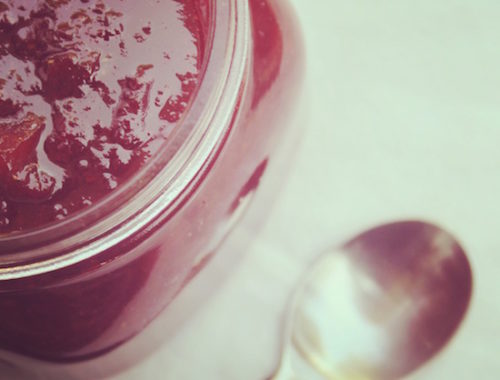
Cherry Rhubarb Jam with Ginger & Honey (No Refined Sugar)

Cherry Rhubarb Jam with Ginger & Honey | Hitchhiking to Heaven

This week, I got to drive down to the central coast of California to spend a couple of days in Big Sur. That meant passing through some of the best fruit and veggie growing regions in the state. More particularly, it meant bringing home four pounds of early variety Brooks cherries from a roadside stand in Gilroy.

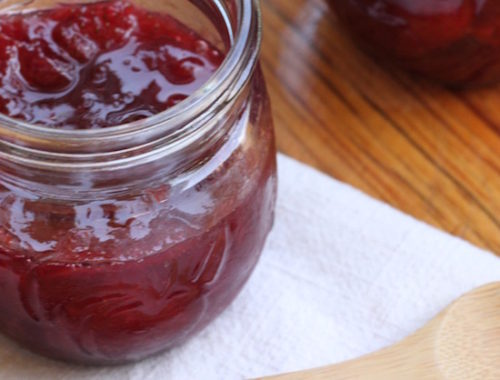
I already had an idea of what I wanted to do with these cherries. A couple months ago, Kate at Snowflake Kitchen had been talking about a cherry ginger jam that I bookmarked in my brain. It’s also time for rhubarb and– gah! — I’m still trying to use up my frozen supply of over-enthusiasm from last year. Because I’m off refined sugar, I wanted to see whether I could put all these things together in a honey-sweetened jam using Pomona’s Pectin.

I’ve used Pomona’s a lot (it was how I first learned to  make jam), but it’s always been with either a small amount of white sugar or with no sugar and concentrated fruit juice for sweetener. (My recipes for blackberry lime jam and cherry blueberry jam are examples of those two methods, respectively.) This is the first time I’ve used only honey as a sweetener with Pomona’s, so I followed the directions pretty close to the letter.

The Esalen Institute | Hitchhiking to Heaven

I like this jam a lot. Here’s a quick list of the best things about it, followed by a few things to consider before you try it yourself:

Pros

  • Neither the fruit nor the honey are cooked for a long time, so the flavor is fresh.
  • It’s nicely tart and plenty sweet enough, and the honey flavor doesn’t overpower.
  • It doesn’t require a lot of honey — just one cup — so the cost of using good honey won’t break you.
  • The set is good — not too loose, not too firm.
  • There’s no refined sugar!

Cons

  • Commercial pectin always has a slightly gummy consistency, so there’s a little of that here.
  • Because there’s no sugar, this jam will lose color quickly. Rhubarb, especially, tends to brown out. You’ll want to eat it all within a few months.
  • There’s no refined sugar!

Finally, I should say that, if you don’t believe in heating honey, this recipe’s not for you. I’ve recently learned that most folks who follow an Ayurvedic diet claim that heated honey becomes toxic. Other sources say that’s a myth with no science to support it. Science does seem to support the idea that heat destroys some of the nutritional benefits of honey. A lot of tested recipes use honey for baking and preserving, however, so I’ll leave it to you to decide what works best in your book.

I’m very happy to have jams like this one on my restricted diet!

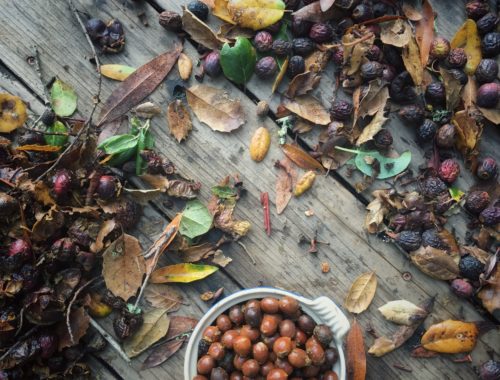
Brooks Cherries | Hitchhiking to Heaven

Cherry Rhubarb Jam with Ginger and Honey

Makes 5-6 half-pint jars

1 cup stewed, mashed rhubarb (about 1/2 pound)
3 cups pitted, mashed cherries (about 2 1/4 pounds)
2 tablespoons finely minced ginger
2 tablespoons lime juice
1 cup wildflower honey (room temperature)
4 teaspoons calcium water*
3 teaspoons pectin powder

* The calcium is in the Pomona’s box with the pectin powder, along with instructions about how to prepare the calcium water; it’s easy. I mix mine in advance and store it in the fridge for a few months.

1. Prepare your jars and lids. (You’ll process the jars for 10 minutes, so they don’t need to be sterilized but they do need to be clean and hot. I prepare my lids by placing them in a small bowl and pouring boiling water over them. The hot jars and lids can sit until you’re ready to use them.)

2. Wash the rhubarb and chop it into 1″ pieces. Put the rhubarb in a small saucepot with a little bit of water (no more than 1/2 cup) and simmer until just soft enough to pierce with a fork. (If your rhubarb happens to be frozen, like mine was, don’t add any water to the pot. Just place the frozen fruit in a covered pot over very low heat and let it soften.)

3. While the rhubarb is simmering, wash and pit the cherries and smush them well with a potato masher. Add the minced ginger and smush some more. When the rhubarb is soft, add it to the cherries and ginger and do a little more smushing. You want to end up with a total of 4 cups of mashed fruit mixture.

4. Put the fruit in a 6- or 8-quart nonreactive, heavy-bottomed pot. Stir in the lime juice and calcium water.

5. Measure the honey into a small bowl and stir in the pectin powder. Mix well.

6. Bring the fruit mixture to a boil for a couple of minutes, add the honey-pectin mixture, and cook, stirring constantly, for 1-2 minutes more. Bring the mixture back to a boil, then remove it from the heat.

7. Pour the jam into jars, leaving 1/4-inch head space. Wipe the rims clean before adding lids, and process 10 minutes in a boiling water bath. (Add 1 minute to the processing time for every 1,000 feet above sea level.)

Enjoy!

Garden Journal: How to Prune a Freeze-Damaged Citrus Tree

Eureka lemon tree in patio container

I’m slowly getting better at gardening. Partly, it has to do with simplifying. Instead of trying to grow everything, I’ve been concentrating on what I love most. More than anything else, I seem to love little trees, especially my citrus trees. I haven’t gone so far as to name them, but I relate to each one as an individual. I check up on them every day and talk to them more than you might think is normal. That tree above is my pride, a Eureka lemon that I brought back from near death when I inherited it.

This winter, we had a lot of frosts and freezes. That meant covering the citrus trees in the evening and uncovering them in the morning. Repeat, repeat, repeat. I have a whole system for it — each of the seven trees has its own labeled cover — but still it got damned tedious. So I can’t judge my beloved neighbor, who’s had plenty to deal with of late, for letting winter get a grip on her big lemon tree this year. Her hen, Isabella, appears to have some thoughts about it, however . . .

Frost damaged Eureka lemon tree

My neighbor Joanne is one of the main reasons this blog amounts to anything at all. She provides me with the best chicken and duck eggs, fresh cut flowers, and beautiful fruits of many kinds — apples, yellow and white peaches, sometimes persimmons. (Never mind that she chases me away from the raspberries with a broom.) She is also the keeper of my best bird friend, Louis Goose. Several generations of Joanne’s family have lived in the big white house down the street, and I almost always come home from my visits inspired to share something about what I’ve seen or learned there. I was truly happy when she took me up on my offer to help out her bedraggled tree.

It turns out that my pruning shears match Louis . . .

How to Prune a Frost- or Freeze-Damaged Citrus Tree

In case you have a tree that needs help, too, here are the basics of pruning and protecting frost- or freeze-damaged citrus:

1. Don’t prune the tree too early. Wait until all danger of frost has passed and new growth starts to appear on the tree. This way you can see the true extent of the damage and cut away only what has died. Also, pruning too early can encourage tender new growth while it’s still too cold to be safe. Late spring is a good time to prune. (Don’t wait too long, either. Pruning citrus in the fall is usually a bad idea; it can encourage new growth just as the cold season comes on, setting up the very cycle of damage you want to avoid.)

2. Disinfect your pruning tools. Sometimes I forget this step and, lucky me, I’ve never had a problem. But it’s safest to disinfect your tools between pruning jobs. A lot of sources recommend using bleach for this job, but I’m convinced by this paper from a Washington state extension professor who says bleach is not the way. I use rubbing alcohol, which is permitted under national organic standards. Clean off any dirt from the pruners, soak them in the alcohol for a full minute, then dry them well with a soft cloth.

3. Cut back damaged limbs into living wood. Before you make a cut, look for new growth on the branch and consider the overall shape of the tree. Then try to make the cut at a crotch, just above a strong new sprout. Make the cut straight across. If you’re cutting a twig or branch back to its base, don’t leave a stump. Finally, prune only as much as you must. (I was tempted to do a much bigger job on Joanne’s tree, taking out crossed or rubbing branches and lifting it up off the ground a bit, but I resisted. Better to let the tree rest and save the less urgent pruning for next year.)

4. If you trim large branches or limbs that face the sun, consider whitewashing them. I’ve never had to do this, because my trees are small. Even the biggest branches I pruned on Joanne’s tree were less than 1″ across. Still, I should say that all the good sources I read stressed the importance of protecting larger cut branches from sunburn by promptly painting them with a 1:1 solution of white interior latex paint and water.

5. Evaluate whether the tree has reduced needs for water and fertilizer. A freeze damaged tree may need less water than a healthy tree of the same size. Water moderately until the tree has returned to its full size and strength. (Joanne and I had a little discussion about this. She’s been giving her tree more water than usual and it seems to be helping. But only a small percentage of the growth on her tree was actually damaged, and we’ve had a long and unusual spell of dryness and heat. Extra water made sense. You have to feel it out.) The same goes for fertilizer. If you’ve lost many branches and twigs, reduce the amount of fertilizer. Make more frequent, light applications rather than giving the tree a single, heavy dose.

Thats’ it!

Eureka Lemon Tree

In a post about Louis Goose from way back in 2008 (called My Other Boyfriend), I mentioned that Joanne and Louis were going to have to move away. I dreaded that thought five years ago and, now that the “For Sale” sign has finally gone up in front of the house, well, I suppose I’ve had some time to get used to the idea but I still don’t like it one bit. I’m not yet sure where they’re headed, but I’m already planning to visit!

Hollyhock Cookbook Giveaway Winner!

Thanks to everyone who participated in the Hollyhock Garden to Table cookbook giveaway. The winner is Ruth Baldwin, lucky number 49.

Hollyhock Giveaway Winner | Hitchhiking to Heaven

Besides diving into this great cookbook, my favorite part of the giveaway was getting to read everyone’s comments about spring. Ruth is celebrating abundance, and now she has a new cookbook to add to that. Congratulations!

Banana Jam & A Hollyhock Cookbook Giveaway!

Hollyhock Garden to Table Cookbook

I’m excited to share this new cookbook with you. Even if I weren’t personally connected with it, I’d say Hollyhock Garden to Table would be a fine addition to your kitchen resources. What’s fun for me is that I am connected with it, in three small ways:

First, it is written and photographed by two beautiful, creative women whom I know and respect tremendously – Moreka Jolar and Heidi Scheifley. (I wrote about Mo here once before, because she inspires me no end and we happen to share the same birthday.) They regularly write about food and their farm at Ripple Rock Cooks.

Second, this cookbook centers around produce from the organic gardens at the Hollyhock Learning Centre on Cortes Island in British Columbia. I have been there and I have eaten food from Hollyhock’s kitchen, so I can affirm that the adjectives on the back of the book are true. Cortes is stunning. The gardens at Hollyhock are spectacular. The food is imaginative, inspiring, and versatile.

Third, you’ll find two of my recipes in this book: nasturtium pesto and pickled nasturtium pods. (Both are updated versions of the recipes on this blog.) Thank you, Mo and Heidi, for including my work!

Moreka Jolar and Heidi Scheifley

Hollyhock Garden to Table is packed with interesting recipes to try. Chapters include everything from salads to mains, from breads to breakfasts — and of course, desserts. I may be most intrigued by their “accompaniments,” which include strawberry salsa, stinging nettle pesto, fig and port compote, and more. I pride myself on never having used the word “yummy” on this blog, but I’m having to restrain myself from employing it now. This cookbook makes me happy because the recipes seem equal parts delicious and enjoyable to prepare.

For inspiration in this moment of full-on-spring, there’s plenty of rhubarb:

  • Rhubarb Vinaigrette
  • Rhubarb Syrup with Hibiscus or Lemongrass
  • Apple Rhubarb Pandowdy
  • Gluten Free Rhubarb Streusel Muffins
  • Rhubarb Shortcake

And lots of food in jars . . .

Hollyhock Garden to Table Preserves

And while Hollyhock Garden to Table includes an abundance of recipes featuring good, whole grains, I was excited to find many things I can enjoy on my current grain-free, sugar-free, lactose-free — insert audible sigh here — plan. I decided to start with banana jam, and that’s the recipe I get to share with you below.

Also, Mo and Heidi generously provided me with a copy of Hollyhock Garden to Table to give away to you. For a chance to win, please leave a comment on this post, including one thing you’re really enjoying about this spring so far. I know there have been a lot of tragedies of late. I love to look outside to see that the pink jasmine has burst into bloom as usual. Carl the crow is also doing great. A couple times, he has even brought another crow to share his breakfast.

The giveaway closes on Friday, 5/3 at 8 p.m. PST and I’ll announce the winner soon after. (Sorry, but I have to restrict the contest to residents of the U.S. or Canada.) If you don’t want to wait for the giveaway results, you can click right over and buy a copy of this lovely book direct from the authors.

Banana Jam & Almond Flour Pancakes | Hitchhiking to HeavenBanana Jam

from Hollyhock Garden to Table, by Moreka Jolar and Heidi Scheifley

Sugar-free and begging to be sandwiched up with some nut butter, this banana jam has some serious citrus and vanilla punch, with just a pinch of clove and cardamom. Easy as 1-2-3.

Makes 1 cup

3 medium bananas
1 orange, juiced
1 lime, zested and juiced
1/4 teaspoon vanilla powder or 1 teaspoon vanilla extract
pinch of cloves
pinch of cardamom

In a heavy-bottomed skillet, mash the bananas with the remaining ingredients. Cook on medium heat, stirring frequently, for 15 minutes. The jam should get thick and creamy. Allow to cool. Store in a sealed container in the fridge for up to 2 weeks.

My notes: The bananas I used weren’t quite ripe enough. This recipe will work best with sweeter, brown-speckled bananas. Because the bananas were so firm, I gave them a quick whirl in the food processor before cooking the jam. For this tiny batch project, I used my heavy-bottomed 8″ stainless-steel skillet, which worked great. The jam reached the desired thickness after just 8 minutes, perhaps because of its little spin in the food processor. Watch the mixture well and stir it pretty much constantly to keep it the jam from sticking or scorching. I think you’ll be pleased with the results. I was!Banana Jam | Hitchhiking to Heaven


Related Posts Plugin for WordPress, Blogger...